Category: Investing

  • Employer or Employee? Maximize Your Retirement as a Solo-Preneur

    One of the greatest advantages of being an S-Corp owner is that you technically wear two hats: you are the Employer (the company) and you are also the Employee (the individual). When it comes to retirement, this dual identity is your greatest superpower. It allows you to “double dip” into contribution limits that most W-2 workers can only dream of.

    In 2026, the IRS has once again increased the ceilings for retirement savings. If you aren’t strategically splitting your contributions between your employee deferrals and your company profit-sharing, you are leaving wealth on the table.


    The Power of the Solo 401(k)

    While a SEP IRA is a popular choice for simplicity, the Solo 401(k) is the undisputed champion for the aggressive solo-preneur. Here is why the math favors the 401(k) structure in 2026:

    • The Employee Portion: As an employee, you can defer up to 100% of your W-2 salary, up to $24,500. If you are 50 or older, you can add an $8,000 catch-up ($11,250 if you are 60-63).
    • The Employer Portion: Your company can then contribute an additional 25% of your W-2 salary as a profit-sharing contribution.
    • The Total Limit: For 2026, the combined total cannot exceed $72,000 (excluding catch-ups).

    Compare this to a SEP IRA, where you are limited only to the 25% employer side. To hit the $72,000 max in a SEP, you’d need a salary of $288,000. In a Solo 401(k), you could hit that same max with a much lower, more tax-efficient salary.

    Strategic Allocation: Pre-Tax vs. Roth

    Thanks to the SECURE 2.0 Act, many Solo 401(k) plans now allow for Roth Employer Contributions. This means you can choose to pay the taxes now on your company’s portion so that the money grows 100% tax-free forever.

    Choosing between Traditional (pre-tax) and Roth is a game of Tax Arbitrage. If you are in a high tax bracket now but expect to be in an even higher one during retirement (or if you believe tax rates will rise globally), the Roth option is a massive “future-proofing” move for your estate.

    The “Catch-Up” Advantage

    If you are nearing the finish line, 2026 offers unique opportunities. The “Super Catch-Up” for those aged 60–63 allows for an extra $11,250 in employee deferrals. This is the government’s way of letting you make up for lost time. By maximizing both sides of the S-Corp equation, a couple working together in a business can potentially shield over $150,000 of household income from taxes in a single year.


    Optimize Your Retirement Split

    Don’t let your retirement strategy be an afterthought. The Cortex S-Corp Investment Optimizer helps you find the “Goldilocks” balance between employee deferrals and company profit-sharing.

    We’ll calculate exactly how much you can contribute based on your 2026 salary and show you the long-term impact of choosing Roth vs. Traditional. Maximize your savings and protect your legacy.
    Launch the Investment Optimizer →

  • Inflation-Proofing Your Future: The Case for Consistent Contributions

    Inflation is often called the “silent thief” of personal finance. Unlike a market crash, which is loud and visible on every news headline, inflation works quietly in the background, eroding the purchasing power of every dollar you’ve worked hard to save. In early 2026, while we see inflation rates finally cooling toward the 2.4% mark, the reality remains: a dollar today simply does not buy what a dollar bought five years ago.

    At Cortex, we believe the best defense against a devaluing currency isn’t “timing” the market or hoarding cash—it’s the relentless execution of Consistent Contributions.


    The Purchasing Power Gap

    If you leave $10,000 in a standard savings account for 20 years, and inflation averages 3%, that $10,000 will only buy about $5,500 worth of goods in the future. You haven’t “lost” money in the literal sense, but you have lost the utility of that money.

    To keep your financial trajectory pointing upward, your wealth must grow faster than the cost of living. This is where the “Equity Advantage” comes in. Publicly traded companies have pricing power—the ability to raise prices as their own costs increase. When you own the market, you own the very entities that are keeping pace with inflation.

    Why Consistency Beats Intensity

    Many investors wait for a “safe” time to invest, but in an inflationary environment, waiting is a cost in itself. Consistent contributions (often called Dollar-Cost Averaging) allow you to turn inflation’s volatility into your advantage.

    • Automatic Growth: By setting a recurring contribution, you ensure that your “Future Self” is getting paid before the rising cost of groceries or fuel can eat your surplus.
    • Lowering Average Cost: Because you invest the same amount every month, you naturally buy more shares when prices are “discounted” during market dips, which is the ultimate hedge against long-term price increases.

    The Compounding Shield

    The only force powerful enough to outrun inflation over the long term is Compounding. When your investment returns begin to generate their own returns, you create a “shield” around your lifestyle. Even if the price of a loaf of bread doubles over 20 years, a well-fed compound interest engine can quadruple your purchasing power in the same timeframe.

    Don’t let the “noise” of the 2026 economy scare you into standing still. The most inflation-proof action you can take is to start—and stay—consistent.


    See the Power of Consistency

    Is your current savings plan enough to outpace the “silent thief”? The Cortex Compound Interest Calculator helps you visualize your growth trajectory against different contribution schedules.

    Plug in your monthly contribution and see exactly how much wealth you can build, even in a fluctuating economy. Take control of your future purchasing power today.

    Launch the Compound Interest Calculator →

  • The Volatility Myth: Why Seeing Red is Actually Good for Your Growth

    When the stock market turns red and the headlines start screaming about a “correction,” the natural human instinct is to protect what we have. Our brains are hardwired to view a drop in account value as a threat. But for the long-term builder, this is the Volatility Myth: the idea that a falling market is a sign of failure.At Cortex, we want to help you reframe your relationship with market movement. If you are in the “accumulation phase” of your life—meaning you are still adding money to your accounts—market volatility isn’t your enemy. It’s your greatest ally.


    Price is Not Value

    The biggest mistake investors make is confusing the price of a share with the value of the company. When an index fund like VOO drops 10%, the underlying companies (Apple, Amazon, Microsoft) didn’t suddenly become 10% less productive. They are still innovating, hiring, and earning.

    The market has simply put them on sale. Volatility is the price you pay for the “admission ticket” to superior long-term returns. Without the risk of things going down, there would be no premium for things going up.

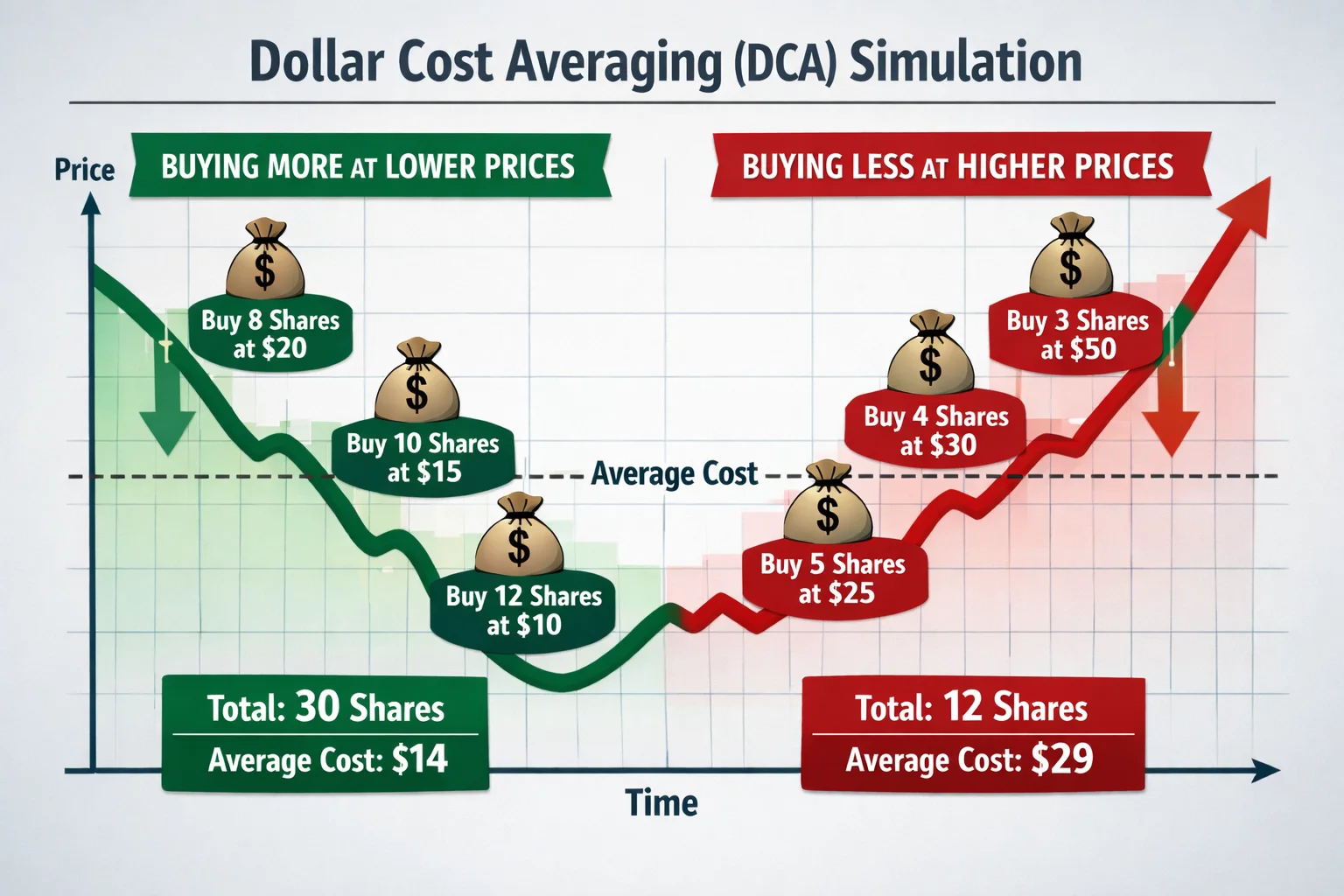
    Dollar-Cost Averaging: The “Discount” Engine

    When you invest a fixed amount every month—regardless of the price—volatility actually works in your favor through a process called Dollar-Cost Averaging (DCA).

    • When markets are high: Your monthly contribution buys fewer shares.
    • When markets are low: Your monthly contribution buys more shares.

    This means you are mathematically forced to buy more when things are “cheap.” Over 20 or 30 years, this “mechanical” buying during downturns is what builds the majority of your terminal wealth. Every “red” day is an opportunity to lower your average cost per share.

    Dollar Cost Averaging

    Reframing the “Drop”

    If you have a 20-year time horizon, you should pray for a bear market early in your career. Why? Because you want to accumulate as many shares as possible while they are inexpensive. The “red” you see today is the fuel for the “green” you will spend in retirement.

    The only time volatility is truly dangerous is when you are forced to sell. As long as you maintain your Financial Hygiene and keep an emergency fund, you never have to sell at the bottom. You can simply wait for the inevitable recovery.


    Don’t Just Feel the Market—Simulate It

    It’s easy to stay calm in a bull market, but how will you react when the index drops 20%? The Cortex Index Fund Growth Visualizer allows you to simulate historical volatility for popular ETFs like VOO and QQQM.

    See exactly how much “red” occurred in the past and how it set the stage for long-term wealth. Build a portfolio that can weather any storm.

    Launch the Growth Visualizer →

  • VOO vs. QQQM: Which Index Fund Deserves a Spot in Your Core?

    If you’ve decided to move away from picking individual stocks and toward the “Ownership” model of index fund investing, you’ve likely encountered two of the most popular tickers in the market: VOO (Vanguard S&P 500 ETF) and QQQM (Invesco NASDAQ 100 Index ETF).

    Both are powerhouses of growth, but they represent very different philosophies of the American economy. Choosing the right one—or the right balance of both—is a key step in optimizing your long-term trajectory. Here is the breakdown of the “Core” versus the “Growth” engine.


    VOO: The Bedrock of the US Economy

    VOO tracks the S&P 500, an index of the 500 largest publicly traded companies in the United States. When you buy VOO, you are betting on the broad health of the US economy. You own tech giants, but you also own healthcare, energy, consumer staples, and industrial companies.

    • The Strategy: Maximum diversification. It is the “standard” for a reason.
    • Volatility: Generally lower than tech-heavy funds because the different sectors often balance each other out.

    QQQM: The Innovation Engine

    QQQM tracks the NASDAQ-100, which consists of the 100 largest non-financial companies listed on the Nasdaq. This is a concentrated bet on innovation, heavily weighted toward Information Technology and Communication Services.

    • The Strategy: Growth-oriented. It focuses on the companies that are defining the future of AI, software, and consumer tech.
    • Volatility: Higher. Because it is concentrated in fewer sectors, it can soar during tech bull markets but drop significantly faster during a downturn.

    The “Overlap” Trap

    A common mistake investors make in 2026 is buying both VOO and QQQM in equal parts, thinking they are diversifying. In reality, there is significant overlap. Because the largest tech companies (Apple, Microsoft, Nvidia) are in both indices, you might inadvertently be creating a portfolio that is 40% or 50% tech-heavy.

    At Cortex, we recommend visualizing your “Core” first. For many, that is a broad fund like VOO. You can then use QQQM as a “Satellite” holding to tilt your portfolio toward growth if your risk tolerance allows for the extra volatility.

    Visualizing Historical Reality

    Investing isn’t just about picking a ticker; it’s about understanding Historical Momentum. Before you commit your capital, you need to see how these funds behaved during the 2008 crash, the 2020 pandemic, and the 2022 inflationary period. Seeing the “red” is just as important as seeing the “green.”


    Simulate Your Portfolio Growth

    Don’t guess which index fund is right for your timeline. The Cortex Index Fund Growth Visualizer allows you to simulate historical returns and volatility for VOO, VTI, QQQM, and more.

    Visualize your contribution schedule against real market data to see which fund best aligns with your risk tolerance and goals. Build your core with confidence.

    Launch the Growth Visualizer →

  • The Eighth Wonder: Visualizing the Quiet Power of Compounding

    Albert Einstein reportedly called compound interest the “eighth wonder of the world,” adding, “He who understands it, earns it… he who doesn’t, pays it.” In 2026, with the speed of information and the pressure for “instant” results, the quiet, relentless power of compounding is more overlooked than ever.

    At Cortex, we don’t believe in get-rich-quick schemes. We believe in the Mathematical Inevitability of time and consistency. Here is how compounding actually works and why the “early” years are the only ones that truly matter.


    The Snowball Effect: Why It Starts Slow

    Compounding is the process where your earnings begin to earn earnings of their own. In the beginning, it feels like watching grass grow. If you invest $1,000 and it grows by 10%, you’ve made $100. It doesn’t feel life-changing.

    However, the next year, you aren’t earning 10% on $1,000; you’re earning it on $1,100. By year 25, that original $1,000 has doubled and redoubled until the 10% gain in a single year is larger than your original investment. This is the “hockey stick” curve of wealth.

    The High Cost of Waiting

    The greatest enemy of compounding isn’t a bad market—it’s Procrastination. Because the curve is exponential, the most valuable dollars you will ever own are the ones you invest today.

    • Investor A starts at age 20, invests $500 a month for 10 years, and then stops.
    • Investor B waits until age 30 and invests $500 a month for the next 30 years.

    Even though Investor B put in three times more money, Investor A will often end up with a larger portfolio simply because their money had a ten-year head start. You can’t get time back, but you can start using it today.

    [Image showing a bar chart of Investor A vs Investor B to demonstrate the cost of waiting]

    Consistency Over Intensity

    Most people wait for a “windfall” to start investing. They wait for the bonus, the tax refund, or the raise. But compounding rewards Consistency. A small, automated monthly contribution is mathematically superior to a large, sporadic one because it maximizes the “time in market.”

    When you automate your contributions, you move your financial trajectory from “hope” to “math.” You stop checking the daily fluctuations and start visualizing the long-term destination.


    See Your Future Wealth

    Are you ready to see what your consistency is worth? The Cortex Compound Interest Calculator allows you to visualize your long-term wealth accumulation with custom contribution schedules and growth rates.

    Stop wondering if you’re doing enough and start seeing the curve. Give your money the gift of time.

    Launch the Compound Interest Calculator →

  • Strategic Allocation: Why Your Business Profit Should Be Your Retirement Fund

    As an entrepreneur, your business is likely your most valuable asset. But there is a massive risk in having 100% of your net worth tied up in a single entity. At Cortex, we teach S-Corp owners that the goal of a business isn’t just to generate “profit”—it’s to generate liquidity that can be strategically allocated into diversified wealth.

    In 2026, the most successful solo-preneurs aren’t just letting their extra cash sit in a business checking account earning 0.01%. They are using a “Strategic Allocation” model to move business wins into personal wealth engines.


    The “Lazy Cash” Leak

    Many business owners keep a massive “safety net” of cash inside their business. While having an operating reserve is essential, “lazy cash” is a silent drain on your trajectory. Because of inflation and missed market growth, every $10,000 of idle business profit is effectively losing value every day.

    The solution is to create a Waterfall Allocation System. Once your business hits its “Operational Reserve” (usually 3–6 months of expenses), every additional dollar should flow over the edge of the waterfall and into your retirement and brokerage accounts.

    Turning Distributions into Diversification

    Because S-Corp distributions are not subject to self-employment tax, they represent your “purest” form of investment capital. Instead of using your distributions for lifestyle upgrades, consider them your Strategic Investment Fund.

    By moving these distributions directly into a diversified index fund (like VOO or VTI), you are doing something revolutionary: you are using the profits from your active business to buy a piece of every other successful business in the world. You are transforming from a business owner into a global investor.

    The Tax-Efficiency Loop

    Strategic allocation creates a powerful feedback loop:

    • Step 1: Use the S-Corp structure to minimize self-employment tax on your profit.
    • Step 2: Take those tax savings and contribute them to a Solo 401(k) or Roth IRA.
    • Step 3: Deduct those contributions from your taxable income, lowering your tax bill even further.

    This loop accelerates your Net Worth Engine far faster than just “saving money” ever could. You are using the IRS’s own rules to fund your freedom.

    Don’t Wait for the “Exit”

    Many founders plan to fund their retirement by selling their business one day. This is a high-risk strategy. Markets change, industries get disrupted, and “exits” aren’t guaranteed. By allocating a portion of your monthly profit into the market now, you ensure that even if your business never sells, your retirement is already fully funded.


    Build Your Retirement Engine

    Your business profit shouldn’t be sitting still. The Cortex S-Corp Investment Optimizer is designed to help you visualize exactly how much business cash you can move into retirement accounts while staying within IRS limits.

    See the long-term impact of consistent allocation and turn your business success into personal freedom. Start building your exit strategy today—one contribution at a time.

    Launch the Investment Optimizer →