Blog

  • The 4% Rule is Dead: Navigating Retirement Withdrawals in a New Era

    For decades, the “4% Rule” was the gold standard of retirement planning. Developed in the 1990s by Bill Bengen, it suggested that if you withdrew 4% of your portfolio in your first year of retirement and adjusted for inflation thereafter, your money would almost certainly last 30 years. It was simple, elegant, and—in the economic landscape of 2026—potentially dangerous.

    At Cortex, we believe that a static rule cannot navigate a dynamic world. Between fluctuating inflation, extended lifespans, and current market valuations, the “set it and forget it” approach to withdrawals is a relic of the past. It’s time to move toward a Flexible Retirement Engine.


    The Sequence of Returns Risk: The Hidden Portfolio Killer

    The biggest flaw in the 4% rule is that it ignores the order of your returns. In your accumulation years, a market crash is a buying opportunity. In your distribution years, a market crash is a catastrophe. This is known as Sequence of Returns Risk.

    If the market drops 20% in your first year of retirement and you still withdraw your scheduled 4%, you are selling shares at the bottom. This permanently shrinks your portfolio’s “seed corn,” making it nearly impossible for the account to recover even when the market bounces back. Early losses in retirement are permanent; late losses are just a nuisance.

    Modern Strategies: Beyond the Single Number

    In 2026, sophisticated retirees are moving toward Dynamic Withdrawal Strategies. Instead of a fixed percentage, they use systems that adapt to the market’s pulse:

    • The Guardrails Approach: You set a target withdrawal (e.g., 4.5%), but you have “guardrails.” If the market does exceptionally well, you give yourself a raise. If the market drops significantly, you trim your spending to protect the principal.
    • The Bucket System: You divide your assets into three buckets: 1) Cash for the next 2 years, 2) Bonds for years 3-10, and 3) Stocks for the long term. This ensures you never have to sell stocks during a downturn just to pay your electric bill.
    • RMD-Based Logic: For those with traditional IRAs, aligning withdrawals with IRS Required Minimum Distributions (which increase as you age) can help ensure you don’t overspend early or leave a massive tax bomb for your heirs.

    Longevity and the “Go-Go” Years

    The 4% rule assumes you spend the same amount (inflation-adjusted) every year. But real life doesn’t work that way. Most retirees follow a “spending smile”:

    1. Go-Go Years (Early Retirement): High spending on travel and hobbies.
    2. Slow-Go Years (Mid Retirement): Spending naturally decreases as activity levels slow down.
    3. No-Go Years (Late Retirement): Spending may spike again, but primarily for healthcare and long-term care.

    By planning for these phases, you can often afford a higher initial withdrawal rate when you are young and healthy enough to enjoy it, rather than hoarding cash for a “worst-case” 30-year scenario that may never happen.


    Stress-Test Your Retirement Plan

    Don’t rely on a 30-year-old rule of thumb to fund your future. The Cortex Retirement Strategy Engine provides a comprehensive simulation of your withdrawals, including RMD calculations, sequence risk testing, and dynamic spending adjustments.

    See exactly how your portfolio holds up against the volatility of 2026 and beyond. Get the clarity you need to retire with confidence, not just hope.

    Launch the Retirement Engine →

  • The Reasonable Salary Trap: How Not to Get Audited by the IRS

    In our last few articles, we explored the massive tax advantages of the S-Corp election. By splitting your income between a W-2 salary and shareholder distributions, you can save thousands in self-employment taxes. But there is a catch: if you set your salary too low, you aren’t just “saving money”—you are waving a red flag at the IRS.

    In 2026, the IRS has prioritized S-Corp compliance as a top enforcement area. The agency is leveraging increased funding and AI-driven data matching to identify owners who are “gaming the system” by taking large distributions and nominal salaries. Here is how to navigate the “Reasonable Salary Trap” and keep your business safe.


    Busting the “60/40 Rule” Myth

    If you’ve spent any time in entrepreneur forums, you’ve likely heard about the “60/40 Rule”: the idea that if you pay yourself 60% as salary and 40% as distributions, you are automatically “safe” from an audit.

    Here is the truth: The IRS does not recognize the 60/40 rule. There is no mathematical safe harbor. The law requires that your compensation be reasonable for the services you perform, regardless of what percentage of the profit it represents. If a comparable CEO makes $150,000 but your “60%” only equals $80,000, you are still underpaid in the eyes of the law.

    The Three Ways the IRS Judges Your Salary

    To determine if your salary is defensible, the IRS and the courts generally look at three primary valuation methods:

    • The Market Approach: What would you have to pay a stranger to do your job? This is the strongest defense. You benchmark your salary against Bureau of Labor Statistics (BLS) data and industry surveys for your specific role and region.
    • The Cost Approach (The “Many Hats” Method): Small business owners often do everything. You might be 10% CEO, 40% Sales Manager, and 50% Lead Developer. You calculate a weighted average salary based on the time spent in each of these roles.
    • The Income Approach: This asks if an “independent investor” would be satisfied with the company’s remaining profit after paying your salary. If your salary is so low that the “investor” gets an impossibly high return, it suggests your wages are being disguised as profit.

    The Cost of Getting It Wrong

    If the IRS determines your salary is unreasonably low, the consequences are severe. They have the power to reclassify your distributions as wages. This triggers:

    • Back Payroll Taxes: You’ll owe the full 15.3% self-employment tax on every reclassified dollar.
    • Penalties and Interest: Standard penalties for underpayment can reach 20% to 40%, plus compounded interest backdated to the original filing.
    • Status Revocation: In extreme cases of fraud, the IRS can revoke your S-Corp status entirely.

    Document Your Determination

    The best audit defense is contemporaneous documentation. Don’t wait for a notice to arrive. Every year, you should create a “Reasonable Compensation Report” that includes your job description, the market data you used, and minutes from a formal board meeting (even if you are the only board member) where the salary was approved.


    Find Your Defensible “Sweet Spot”

    You don’t have to guess at your compliance. The Cortex S-Corp Tax Optimizer helps you find the balance between maximum tax savings and IRS-defensible compensation.

    We’ll help you analyze your profit and roles to identify a salary range that satisfies the “Reasonable” test while keeping your trajectory on track. Secure your savings today.

    Launch the S-Corp Optimizer →

  • Employer or Employee? Maximize Your Retirement as a Solo-Preneur

    One of the greatest advantages of being an S-Corp owner is that you technically wear two hats: you are the Employer (the company) and you are also the Employee (the individual). When it comes to retirement, this dual identity is your greatest superpower. It allows you to “double dip” into contribution limits that most W-2 workers can only dream of.

    In 2026, the IRS has once again increased the ceilings for retirement savings. If you aren’t strategically splitting your contributions between your employee deferrals and your company profit-sharing, you are leaving wealth on the table.


    The Power of the Solo 401(k)

    While a SEP IRA is a popular choice for simplicity, the Solo 401(k) is the undisputed champion for the aggressive solo-preneur. Here is why the math favors the 401(k) structure in 2026:

    • The Employee Portion: As an employee, you can defer up to 100% of your W-2 salary, up to $24,500. If you are 50 or older, you can add an $8,000 catch-up ($11,250 if you are 60-63).
    • The Employer Portion: Your company can then contribute an additional 25% of your W-2 salary as a profit-sharing contribution.
    • The Total Limit: For 2026, the combined total cannot exceed $72,000 (excluding catch-ups).

    Compare this to a SEP IRA, where you are limited only to the 25% employer side. To hit the $72,000 max in a SEP, you’d need a salary of $288,000. In a Solo 401(k), you could hit that same max with a much lower, more tax-efficient salary.

    Strategic Allocation: Pre-Tax vs. Roth

    Thanks to the SECURE 2.0 Act, many Solo 401(k) plans now allow for Roth Employer Contributions. This means you can choose to pay the taxes now on your company’s portion so that the money grows 100% tax-free forever.

    Choosing between Traditional (pre-tax) and Roth is a game of Tax Arbitrage. If you are in a high tax bracket now but expect to be in an even higher one during retirement (or if you believe tax rates will rise globally), the Roth option is a massive “future-proofing” move for your estate.

    The “Catch-Up” Advantage

    If you are nearing the finish line, 2026 offers unique opportunities. The “Super Catch-Up” for those aged 60–63 allows for an extra $11,250 in employee deferrals. This is the government’s way of letting you make up for lost time. By maximizing both sides of the S-Corp equation, a couple working together in a business can potentially shield over $150,000 of household income from taxes in a single year.


    Optimize Your Retirement Split

    Don’t let your retirement strategy be an afterthought. The Cortex S-Corp Investment Optimizer helps you find the “Goldilocks” balance between employee deferrals and company profit-sharing.

    We’ll calculate exactly how much you can contribute based on your 2026 salary and show you the long-term impact of choosing Roth vs. Traditional. Maximize your savings and protect your legacy.

    Launch the Investment Optimizer →

  • The S-Corp Secret: How to Save $5k+ in Self-Employment Taxes

    If you are a freelancer, consultant, or small business owner operating as a standard Sole Proprietorship or a single-member LLC, you might be overpaying the IRS by thousands of dollars every year. The culprit? Self-employment tax.

    In 2026, the tax burden on independent earners remains one of the largest obstacles to business growth. But there is a legal, strategic path used by savvy entrepreneurs to lower that burden: the S-Corp Election. At Cortex, we want to help you keep more of what you earn so you can reinvest it in your trajectory.


    The Problem: The 15.3% “Success Tax”

    When you work for an employer, you pay half of your Social Security and Medicare taxes (7.65%), and your employer pays the other half. When you are self-employed, you are both the employer and the employee—meaning you pay the full 15.3% on every dollar of your business profit.

    As your income grows, this 15.3% becomes a massive drag on your liquidity. This is where the S-Corp structure changes the game.

    The Solution: The Salary/Distribution Split

    By electing to be treated as an S-Corporation for tax purposes, you stop being a “business owner” in the eyes of the IRS and start being an “employee” of your own company. This allows you to split your income into two categories:

    • Reasonable Salary: You pay yourself a W-2 wage. You pay self-employment (FICA) taxes only on this portion.
    • Shareholder Distributions: The remaining profit is passed through to you as a distribution. This portion is exempt from the 15.3% self-employment tax.

    If your business clears $100,000 in profit and you set a reasonable salary of $60,000, you only pay self-employment tax on that $60,000. The remaining $40,000 is taxed at your income rate, but you’ve effectively saved over $6,000 in taxes instantly.

    The “Reasonable Salary” Trap

    The IRS requires that your salary be “reasonable” for the work you perform. You can’t set your salary at $0 to avoid all taxes—that is a fast track to an audit. Finding the “Goldilocks” zone—where your salary is high enough to satisfy the IRS but low enough to maximize your tax savings—is the key to a successful S-Corp strategy.

    When done correctly, an S-Corp election is like giving yourself a $5,000 to $10,000 annual raise that the IRS can’t touch. That is capital that could be funding your marketing, your next hire, or your S-Corp Investment Strategy.


    Calculate Your S-Corp Savings

    Is it time to make the switch? Don’t leave your tax strategy to guesswork. The Cortex S-Corp Tax Optimizer helps you calculate your potential self-employment tax savings based on your business profit.

    Find your ideal salary/distribution split and see exactly how much you could be saving every year. Stop overpaying and start optimizing.

    Launch the S-Corp Optimizer →

  • Inflation-Proofing Your Future: The Case for Consistent Contributions

    Inflation is often called the “silent thief” of personal finance. Unlike a market crash, which is loud and visible on every news headline, inflation works quietly in the background, eroding the purchasing power of every dollar you’ve worked hard to save. In early 2026, while we see inflation rates finally cooling toward the 2.4% mark, the reality remains: a dollar today simply does not buy what a dollar bought five years ago.

    At Cortex, we believe the best defense against a devaluing currency isn’t “timing” the market or hoarding cash—it’s the relentless execution of Consistent Contributions.


    The Purchasing Power Gap

    If you leave $10,000 in a standard savings account for 20 years, and inflation averages 3%, that $10,000 will only buy about $5,500 worth of goods in the future. You haven’t “lost” money in the literal sense, but you have lost the utility of that money.

    To keep your financial trajectory pointing upward, your wealth must grow faster than the cost of living. This is where the “Equity Advantage” comes in. Publicly traded companies have pricing power—the ability to raise prices as their own costs increase. When you own the market, you own the very entities that are keeping pace with inflation.

    Why Consistency Beats Intensity

    Many investors wait for a “safe” time to invest, but in an inflationary environment, waiting is a cost in itself. Consistent contributions (often called Dollar-Cost Averaging) allow you to turn inflation’s volatility into your advantage.

    • Automatic Growth: By setting a recurring contribution, you ensure that your “Future Self” is getting paid before the rising cost of groceries or fuel can eat your surplus.
    • Lowering Average Cost: Because you invest the same amount every month, you naturally buy more shares when prices are “discounted” during market dips, which is the ultimate hedge against long-term price increases.

    The Compounding Shield

    The only force powerful enough to outrun inflation over the long term is Compounding. When your investment returns begin to generate their own returns, you create a “shield” around your lifestyle. Even if the price of a loaf of bread doubles over 20 years, a well-fed compound interest engine can quadruple your purchasing power in the same timeframe.

    Don’t let the “noise” of the 2026 economy scare you into standing still. The most inflation-proof action you can take is to start—and stay—consistent.


    See the Power of Consistency

    Is your current savings plan enough to outpace the “silent thief”? The Cortex Compound Interest Calculator helps you visualize your growth trajectory against different contribution schedules.

    Plug in your monthly contribution and see exactly how much wealth you can build, even in a fluctuating economy. Take control of your future purchasing power today.

    Launch the Compound Interest Calculator →

  • The Volatility Myth: Why Seeing Red is Actually Good for Your Growth

    When the stock market turns red and the headlines start screaming about a “correction,” the natural human instinct is to protect what we have. Our brains are hardwired to view a drop in account value as a threat. But for the long-term builder, this is the Volatility Myth: the idea that a falling market is a sign of failure.At Cortex, we want to help you reframe your relationship with market movement. If you are in the “accumulation phase” of your life—meaning you are still adding money to your accounts—market volatility isn’t your enemy. It’s your greatest ally.


    Price is Not Value

    The biggest mistake investors make is confusing the price of a share with the value of the company. When an index fund like VOO drops 10%, the underlying companies (Apple, Amazon, Microsoft) didn’t suddenly become 10% less productive. They are still innovating, hiring, and earning.

    The market has simply put them on sale. Volatility is the price you pay for the “admission ticket” to superior long-term returns. Without the risk of things going down, there would be no premium for things going up.

    Dollar-Cost Averaging: The “Discount” Engine

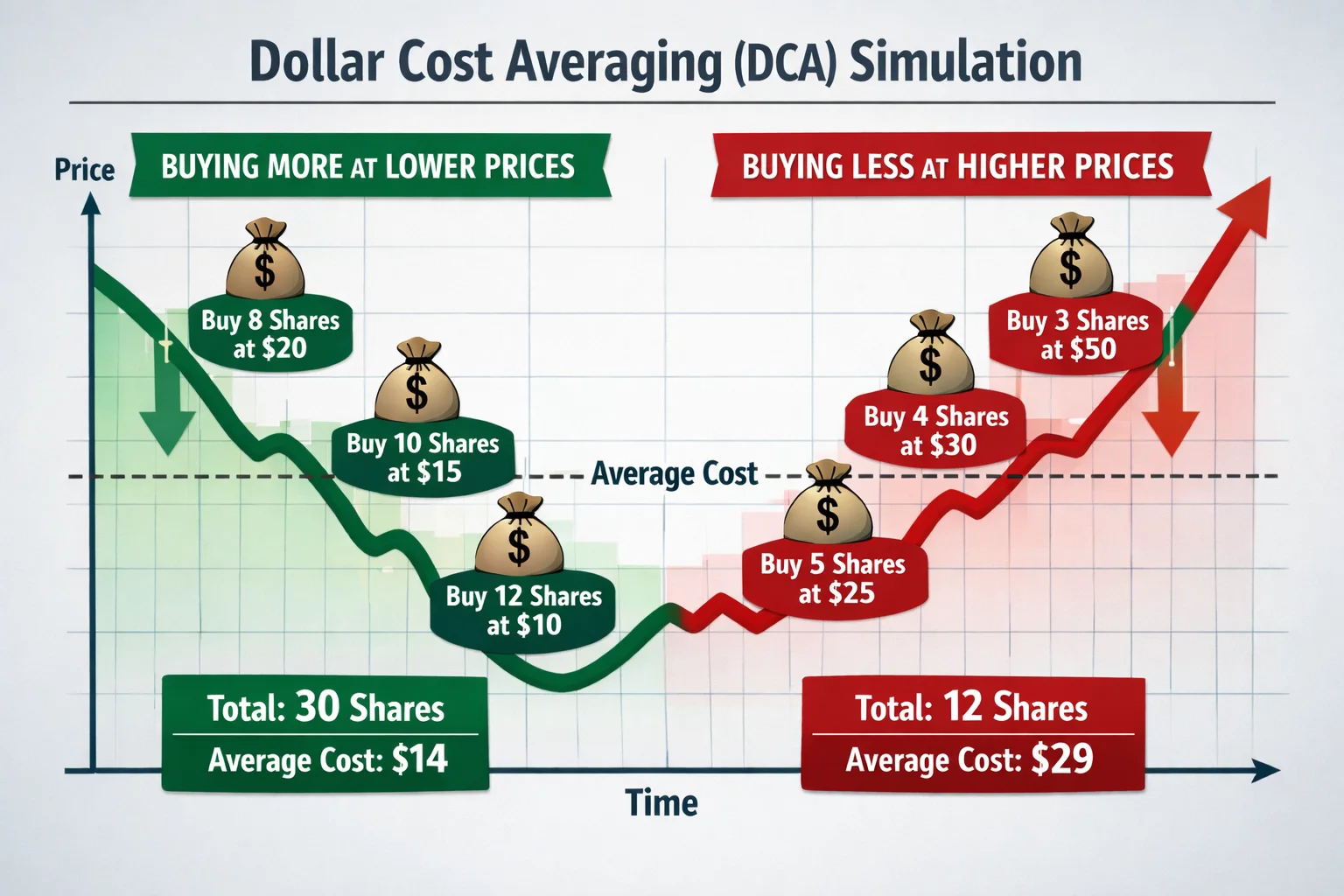
    When you invest a fixed amount every month—regardless of the price—volatility actually works in your favor through a process called Dollar-Cost Averaging (DCA).

    • When markets are high: Your monthly contribution buys fewer shares.
    • When markets are low: Your monthly contribution buys more shares.

    This means you are mathematically forced to buy more when things are “cheap.” Over 20 or 30 years, this “mechanical” buying during downturns is what builds the majority of your terminal wealth. Every “red” day is an opportunity to lower your average cost per share.

    Dollar Cost Averaging

    Reframing the “Drop”

    If you have a 20-year time horizon, you should pray for a bear market early in your career. Why? Because you want to accumulate as many shares as possible while they are inexpensive. The “red” you see today is the fuel for the “green” you will spend in retirement.

    The only time volatility is truly dangerous is when you are forced to sell. As long as you maintain your Financial Hygiene and keep an emergency fund, you never have to sell at the bottom. You can simply wait for the inevitable recovery.


    Don’t Just Feel the Market—Simulate It

    It’s easy to stay calm in a bull market, but how will you react when the index drops 20%? The Cortex Index Fund Growth Visualizer allows you to simulate historical volatility for popular ETFs like VOO and QQQM.

    See exactly how much “red” occurred in the past and how it set the stage for long-term wealth. Build a portfolio that can weather any storm.

    Launch the Growth Visualizer →

  • VOO vs. QQQM: Which Index Fund Deserves a Spot in Your Core?

    If you’ve decided to move away from picking individual stocks and toward the “Ownership” model of index fund investing, you’ve likely encountered two of the most popular tickers in the market: VOO (Vanguard S&P 500 ETF) and QQQM (Invesco NASDAQ 100 Index ETF).

    Both are powerhouses of growth, but they represent very different philosophies of the American economy. Choosing the right one—or the right balance of both—is a key step in optimizing your long-term trajectory. Here is the breakdown of the “Core” versus the “Growth” engine.


    VOO: The Bedrock of the US Economy

    VOO tracks the S&P 500, an index of the 500 largest publicly traded companies in the United States. When you buy VOO, you are betting on the broad health of the US economy. You own tech giants, but you also own healthcare, energy, consumer staples, and industrial companies.

    • The Strategy: Maximum diversification. It is the “standard” for a reason.
    • Volatility: Generally lower than tech-heavy funds because the different sectors often balance each other out.

    QQQM: The Innovation Engine

    QQQM tracks the NASDAQ-100, which consists of the 100 largest non-financial companies listed on the Nasdaq. This is a concentrated bet on innovation, heavily weighted toward Information Technology and Communication Services.

    • The Strategy: Growth-oriented. It focuses on the companies that are defining the future of AI, software, and consumer tech.
    • Volatility: Higher. Because it is concentrated in fewer sectors, it can soar during tech bull markets but drop significantly faster during a downturn.

    The “Overlap” Trap

    A common mistake investors make in 2026 is buying both VOO and QQQM in equal parts, thinking they are diversifying. In reality, there is significant overlap. Because the largest tech companies (Apple, Microsoft, Nvidia) are in both indices, you might inadvertently be creating a portfolio that is 40% or 50% tech-heavy.

    At Cortex, we recommend visualizing your “Core” first. For many, that is a broad fund like VOO. You can then use QQQM as a “Satellite” holding to tilt your portfolio toward growth if your risk tolerance allows for the extra volatility.

    Visualizing Historical Reality

    Investing isn’t just about picking a ticker; it’s about understanding Historical Momentum. Before you commit your capital, you need to see how these funds behaved during the 2008 crash, the 2020 pandemic, and the 2022 inflationary period. Seeing the “red” is just as important as seeing the “green.”


    Simulate Your Portfolio Growth

    Don’t guess which index fund is right for your timeline. The Cortex Index Fund Growth Visualizer allows you to simulate historical returns and volatility for VOO, VTI, QQQM, and more.

    Visualize your contribution schedule against real market data to see which fund best aligns with your risk tolerance and goals. Build your core with confidence.

    Launch the Growth Visualizer →

  • The Eighth Wonder: Visualizing the Quiet Power of Compounding

    Albert Einstein reportedly called compound interest the “eighth wonder of the world,” adding, “He who understands it, earns it… he who doesn’t, pays it.” In 2026, with the speed of information and the pressure for “instant” results, the quiet, relentless power of compounding is more overlooked than ever.

    At Cortex, we don’t believe in get-rich-quick schemes. We believe in the Mathematical Inevitability of time and consistency. Here is how compounding actually works and why the “early” years are the only ones that truly matter.


    The Snowball Effect: Why It Starts Slow

    Compounding is the process where your earnings begin to earn earnings of their own. In the beginning, it feels like watching grass grow. If you invest $1,000 and it grows by 10%, you’ve made $100. It doesn’t feel life-changing.

    However, the next year, you aren’t earning 10% on $1,000; you’re earning it on $1,100. By year 25, that original $1,000 has doubled and redoubled until the 10% gain in a single year is larger than your original investment. This is the “hockey stick” curve of wealth.

    The High Cost of Waiting

    The greatest enemy of compounding isn’t a bad market—it’s Procrastination. Because the curve is exponential, the most valuable dollars you will ever own are the ones you invest today.

    • Investor A starts at age 20, invests $500 a month for 10 years, and then stops.
    • Investor B waits until age 30 and invests $500 a month for the next 30 years.

    Even though Investor B put in three times more money, Investor A will often end up with a larger portfolio simply because their money had a ten-year head start. You can’t get time back, but you can start using it today.

    [Image showing a bar chart of Investor A vs Investor B to demonstrate the cost of waiting]

    Consistency Over Intensity

    Most people wait for a “windfall” to start investing. They wait for the bonus, the tax refund, or the raise. But compounding rewards Consistency. A small, automated monthly contribution is mathematically superior to a large, sporadic one because it maximizes the “time in market.”

    When you automate your contributions, you move your financial trajectory from “hope” to “math.” You stop checking the daily fluctuations and start visualizing the long-term destination.


    See Your Future Wealth

    Are you ready to see what your consistency is worth? The Cortex Compound Interest Calculator allows you to visualize your long-term wealth accumulation with custom contribution schedules and growth rates.

    Stop wondering if you’re doing enough and start seeing the curve. Give your money the gift of time.

    Launch the Compound Interest Calculator →

  • Leasing vs. Buying in 2026: The New Math on Depreciation

    The old-school financial advice was simple: “Never lease. It’s just renting a car you’ll never own.” But as we move through 2026, the rapid evolution of automotive technology—specifically in the Electric Vehicle (EV) and software-defined vehicle space—has flipped the script. The math of depreciation has changed, and blindly buying could be a costlier mistake than leasing.

    At Cortex, we focus on Total Cost of Ownership (TCO). Whether you lease or buy, the goal is the same: minimize the amount of your net worth that “evaporates” into a driveway ornament.


    The Tech Obsolescence Factor

    In the past, a five-year-old car was just a slightly older version of a new car. Today, a five-year-old EV can feel like a five-year-old smartphone. Rapid improvements in battery density, charging speeds, and autonomous hardware mean that older models can see “cliff-like” depreciation.

    Leasing acts as a hedge against this technological obsolescence. You aren’t just paying for a car; you are paying for an option to walk away in three years if the technology has been surpassed. You shift the “Residual Value Risk” from your balance sheet to the bank’s.

    When Buying Still Wins

    Despite the tech shifts, Buying (especially used) remains the champion of pure mathematical efficiency for many. Buying makes sense if:

    • You Drive High Mileage: Leases penalize you heavily for exceeding 10,000–12,000 miles per year.
    • You Keep Cars for 7+ Years: The cheapest car you will ever drive is the one you already own that is fully paid off.
    • You Value Asset Ownership: Once the loan is gone, the car remains an asset on your Net Worth Engine, even if its value is declining.

    The “Opportunity Cost” of the Down Payment

    Leases often require “zero down” or very low drive-off fees. Buying usually requires a significant chunk of change up front to follow the 20/3/8 rule. If you take $10,000 and put it into a car down payment, that is $10,000 that isn’t sitting in an index fund compounding for your future.

    When interest rates are high, the “cost” of that down payment includes the 8–10% return you could have earned in the market. This is the Invisible Leak in most car-buying calculations.

    Total Cost of Ownership: The Only Number That Matters

    To make the right choice, you have to look past the monthly payment. You must calculate the insurance premiums (often higher on leases), the maintenance costs (often included in leases), and the projected resale value. In 2026, the “winning” choice is the one that leaves your monthly cash flow with the most “breath” to feed your investments.


    Run Your Own Depreciation Simulation

    Don’t let a dealer’s “four-square” worksheet confuse you. The Cortex Car Affordability Calculator helps you break down the true math of leasing versus buying based on your specific mileage and tax situation.

    See exactly how each option impacts your long-term wealth trajectory before you sign the dotted line. Drive what you love, but keep your net worth in the fast lane.

    Launch the Car Calculator →

  • The ‘Hybrid’ Debt Strategy: How to Optimize for Both Math and Mindset

    When it comes to debt, we often feel forced to choose a side: are you a “Snowballer” who craves psychological wins, or an “Avalanche” follower who demands mathematical efficiency? The truth is, for most people in 2026, the rigid binary between these two methods creates a point of failure.

    Enter the Hybrid Debt Strategy. This approach recognizes that while interest rates matter, your human need for momentum is the real fuel for your financial engine. By blending the two methods, you can optimize for both your wallet and your willpower.


    The Psychology of the “Starter Win”

    The biggest risk in the Debt Avalanche (paying highest interest first) is the Motivation Gap. If your highest-interest debt is a $25,000 credit card balance, you could pay for 12 months without ever seeing an account close. That feeling of “running in place” is why many people give up.

    The Hybrid Strategy starts with a Snowball Sprint. You identify the 1 or 2 smallest balances—regardless of interest rate—and eliminate them immediately. Closing those accounts provides the dopamine hit needed to prove to yourself that your system is working.

    Switching to the “Efficiency Engine”

    Once those small psychological hurdles are cleared, the Hybrid Strategy shifts gears into the Avalanche Phase. With the momentum of your initial wins, you pivot your focus to the debt with the highest interest rate. This ensures that as you move into the “long haul” of debt paydown, you are minimizing the amount of money leaking out of your net worth through interest charges.

    By using this “Sprint then Pivot” model, you solve the two biggest problems in debt management:

    • Early Burnout: Solved by the initial Snowball wins.
    • Interest Fatigue: Solved by the subsequent Avalanche efficiency.

    Is the Hybrid Strategy Right for You?

    The Hybrid Strategy is ideal for anyone who feels overwhelmed by multiple lines of credit. It’s about Opportunity Cost Analysis—understanding that the “cost” of paying a little extra interest on a small balance is worth the “gain” of the psychological momentum it creates.

    In the Cortex ecosystem, we don’t just look at the numbers; we look at the trajectory. Eliminating debt is the fastest way to increase your liquidity and lower your financial tension metrics.


    Optimize Your Path to Zero

    Don’t get stuck in a one-size-fits-all debt plan. The Cortex Debt Paydown Strategy Optimizer allows you to toggle between Snowball, Avalanche, and Hybrid models in real-time.

    We’ll show you the exact date you’ll be debt-free under each scenario, including the “psychological weight” of each debt. Take control of your debt and clear the path for your wealth to grow.

    Launch the Debt Optimizer →